How Do You Know if Your Snake Is a Corn Snake
| Corn snake | |
|---|---|
 | |
| Conservation condition | |
| | |
Scientific classification  | |
| Kingdom: | Animalia |
| Phylum: | Chordata |
| Class: | Reptilia |
| Order: | Squamata |
| Suborder: | Serpentes |
| Family: | Colubridae |
| Genus: | Pantherophis |
| Species: | P. guttatus |
| Binomial name | |
| Pantherophis guttatus (Linnaeus, 1766) | |
 | |
| Synonyms | |
| |


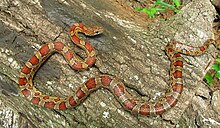
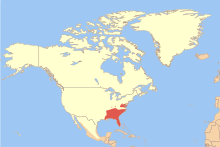
The corn snake (Pantherophis guttatus) is a Due north American species of rat snake that subdues its modest prey past constriction.[4] [5] It is found throughout the southeastern and key United States. Though superficially resembling the venomous copperhead and often killed every bit a result of this mistaken identity, corn snakes lack functional venom and are harmless. Corn snakes are beneficial to humans [6] by helping to control populations of wild rodent pests that damage crops and spread disease.[7]
The corn ophidian is named for the species' regular presence about grain stores, where it preys on mice and rats that eat harvested corn (maize).[8] The Oxford English Dictionary cites this usage as far back every bit 1675, whilst other sources maintain that the corn serpent is and then-named considering the distinctive, nearly-checkered pattern of the ophidian'southward belly scales resembles the kernels of variegated corn.[9] [10]
Description [edit]
Developed corn snakes take a body length of 61–182 cm (2.00–v.97 ft).[eleven] In the wild, they unremarkably live around six to eight years, simply in captivity tin alive to an age of 23 years or more than.[12] The record for the oldest corn snake in captivity was 32 years and three months.[13] They can be distinguished from copperheads by their brighter colors, slender build, round pupils, and lack of heat-sensing pits.[14]
Taxonomy [edit]
Until 2002, the corn snake was considered to have two subspecies: the nominate subspecies (P. g. guttatus) described here and the Dandy Plains rat snake (P. one thousand. emoryi). The latter has since been separate off equally its own species (P. emoryi), but is still occasionally treated as a subspecies of the corn snake by hobbyists.
P. guttatus has been suggested to be split into three species: the corn snake (P. guttatus), the Great Plains rat ophidian (P. emoryi, corresponding with the subspecies P. thousand. emoryi) and Slowinski's corn serpent (P. slowinskii, occurring in western Louisiana and adjacent Texas).[fifteen]
P. guttatus was previously placed in the genus Elaphe, but Elaphe was plant to exist paraphyletic by Utiger et al., leading to placement of this species in the genus Pantherophis.[16] The placement of P. guttatus and several related species in Pantherophis rather than Elaphe has been confirmed by further phylogenetic studies.[17] [18] Many reference materials nonetheless use the synonym Elaphe guttata.[19] Molecular data accept shown that corn snakes are actually more than closely related to kingsnakes (genus Lampropeltis) than they are to the Onetime World rat snakes with which they were formerly classified. Corn snakes have even been bred in captivity with California kingsnakes to produce fertile hybrids known as "jungle corn snakes".[twenty]
Range [edit]
Natural habitat [edit]
Wild corn snakes prefer habitats such every bit overgrown fields, forest openings, trees, palmetto flatwoods, and abandoned or seldom-used buildings and farms, from bounding main level to as high every bit 6,000 anxiety. Typically, these snakes remain on the footing until the age of four months but can arise trees, cliffs, and other elevated surfaces.[21] They can exist constitute in the Southeastern United states of america ranging from New Bailiwick of jersey to the Florida Keys.
In colder regions, snakes brumate during winter. Withal, in the more than temperate climate along the coast, they shelter in rock crevices and logs during cold weather; they also can find shelter in modest, closed spaces, such as nether a house, and come up out on warm days to soak up the heat of the sun. During cold atmospheric condition, snakes are less active, so they hunt less.[22] [23]
Introduced range [edit]
Often called the "American corn snake", P. guttatus is a proscribed pest in much of Australia. At that place are agile extermination campaigns and advice for the public in Victoria,[24] New Southward Wales,[25] and Queensland.[26]
Reproduction [edit]
Information technology has been constitute that corn snakes (along with other colubrids) achieve sexual maturity by means of size, as opposed to age. [27]
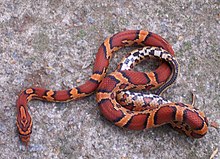
Young Okeetee Phase corn serpent

Baby corn snakes hatching from their eggs
Corn snakes are relatively easy to breed. Although not necessary, they are ordinarily put through a cooling (too known as brumation) period that takes 60–ninety days to become them ready for breeding. Corn snakes brumate around ten to xvi °C (50 to 61 °F) in a place where they cannot be disturbed and with footling sunlight.[ citation needed ]
Corn snakes ordinarily breed presently later the winter cooling. The male courts the female primarily with tactile and chemical cues, and so everts one of his hemipenes, inserts it into the female, and ejaculates his sperm. If the female is ovulating, the eggs will be fertilized and she will begin sequestering nutrients into the eggs, and then secreting a beat.[ citation needed ]
Egg-laying occurs slightly more than a month after mating, with 12–24 eggs deposited into a warm, moist, hidden location. One time laid, the developed ophidian abandons the eggs and does not return to them. The eggs are oblong with leathery, flexible shells. About 10 weeks later on laying, the young snakes use a specialized calibration called an egg tooth to slice slits in the egg shell, from which they sally at about 5 in long.[28]
Reproduction in captivity has to be washed correctly and so the clutch's bloodshed rate decreases. This includes authentic sexing, establishing proper pre-breeding conditioning, and timely pairing of adults. Corn snakes are temperate zone colubrids, and share a reproductive blueprint where females increase their feeding during summer and fall. This only applies to corn snakes that are sexually mature, which typically indicates the ophidian is effectually 75 cm (30 inches) in length or weight 250 g.[29]
Nutrition [edit]

Captive corn serpent eating immature mouse
Similar all snakes, corn snakes are carnivorous and, in the wild, they consume every few days. While most corn snakes consume small-scale rodents, such equally the white-footed mouse, they may also swallow other reptiles, or amphibians, or climb trees to observe unguarded bird eggs.[30]
Seasons play a big role in the thermal regulation patterns of corn snakes, which is the main mechanism of digestion for snakes. During the autumn season corn snakes maintain a torso temperatures that was 3.0 degrees Celsius college than the surrounding environment afterwards consuming a repast.[31] While corn snakes in the winter were seen to not thermoregulate after digestion. Captive snakes practice this by using heat mats as an underneath heat source replicates their natural atmospheric condition. Corns snakes demonstrate nocturnal patterns, and use the warm ground at night to thermoregulate, therefore heat mats replicate this source.
American "rat snakes", such as P. guttatus, had venomous ancestors, which lost their venom afterward they evolved constriction equally a means of prey capture.[32]
Intelligence and behavior [edit]
Like many species of the Colubridae, corn snakes showroom defensive tail vibration behavior.[33] Behavioral / chemosensory studies with corn snakes propose that odor cues are of primary importance for prey detection, whereas visual cues are of secondary importance.[34] [35]
However; a study conducted by Dr. David Holzman of the Academy of Rochester in 1999 found that snakes' cerebral abilities (in specific regards to spatial learning) actually rival that of birds and rodents.[36] Holzman challenged the typical testing method that was being used by biologists to examine snakes' navigational abilities, challenge the structure of the arena itself was biologically in favor of rodents. He hypothesized that if the typical arena beingness used to test the animals was modified to cater to ophidian's innate biologically driven goals, thus providing them with trouble sets that they would likely see in their natural environs, this would give a more accurate view of their intelligence.
The study involved testing 24 captive-bred corn snakes, placing them in a wide-open up tub with walls likewise loftier for them to climb out. Eight holes were cutting out underneath, with one pigsty leading to a shelter. An intense light was positioned to shine directly on the loonshit, exploiting the ophidian's natural aversion to bright open spaces. This provided a biologically meaningful objective for the snakes: to seek out cozy dark shelter.
Non just did they find that, when given proper incentive, the snakes exhibited an acute ability to acquire and navigate their environment. They besides establish snakes rely on their sense of vision much more many herpetologists had previously assumed. They did, all the same, find that younger snakes were able to more than rapidly locate the holes than older snakes, as the younger snakes were more resourceful in their awarding of senses – where the older snakes more than heavily relied on their sense of sight.[37]
In captivity [edit]
Corn snakes are one of the most popular types of snakes to go along in captivity or as pets, second only to the ball python. However, they are the about pop pet serpent in Brazil. Their size, calm temperament, and ease of care contribute to this popularity. Convict corn snakes tolerate being handled past their owners, even for extended periods.[38]
Variations [edit]

A docile young corn snake (an introduced species) captured from the wild on the island of Nevis, Westward Indies, in 2009
Later on many generations of selective breeding, convict bred corn snakes are institute in a wide diversity of different colors and patterns. These result from recombining the dominant and recessive genes that code for proteins involved in chromatophore evolution, maintenance, or function. New variations, or morphs, get available every year every bit breeders gain a better understanding of the genetics involved.
Color morphs [edit]
- Normal / Carolina / Wildtype – Orange with blackness lines around red-colored saddle markings going downwards their back and with black-and-white checky bellies. Regional diversity is found in wild-defenseless corn snakes, the near popular beingness the Miami and Okeetee Phases. These are the almost commonly seen corn snakes.
- Miami Stage (originates in the Florida Wildtype) – Usually smaller corn snakes with some specimens having highly contrasting light silver to gray footing color with cherry or orange saddle markings surrounded in black. Selective breeding has lightened the footing color and darkened the saddle marks. The "Miami" name is now considered an appearance trait.
- Okeetee Phase – Characterized by deep reddish dorsal saddle marks, surrounded past very blackness borders on a bright orange footing colour. As with the Miami Stage, selective breeding has changed the term "Okeetee" to an appearance rather than a locality. Some on the market originate solely from selectively breeding corn snakes from the Okeetee Hunt Club.
- Processed-cane (selectively bred amelanistic) – Amelanistic corn snakes, bred toward the ideal of red or orange saddle marks on a white background. Some were produced using light Creamsicle (an amel hybrid from Great Plains rat snake x corn snake crosses) bred with Miami Stage corn snakes. Some Candy-canes will develop orange coloration around the neck region equally they mature and many labeled as Candy-canes later develop meaning amounts of yellow or orange in the ground color. The contrast they take as hatchlings frequently fades with maturity.
- Reverse Okeetee (selectively bred amelanistic) – An amelanistic Okeetee Phase corn snake, which has the normal black rings around the saddle marks replaced with wide white rings. Ideal specimens are loftier contrast snakes with calorie-free orange to yellow background and dark orange/ruby saddles. Notation: An Albino Okeetee is not a locale-specific Okeetee—it is a selectively bred amelanistic.
- Fluorescent Orange (selectively bred amelanistic) – A designer amelanistic corn snake that develops white borders around bright cherry saddle marks as adults on an orangish background.
- Sunglow (selectively bred amelanistic) – Another designer amelanistic corn snake that lacks the usual white speckling that often appears in most albinos and selected for uncommonly bright footing color. The orangish background surrounds night orange saddle marks.
- Blood Red (selectively bred "diffused") – Carry a recessive trait (known every bit diffused) that eliminates the ventral checkered patterns. These originated from a somewhat unicolor Jacksonville, Florida and Gainesville, Florida strain of corn snake. Through selective breeding, an almost solid ground color has been produced. Hatchlings have a visible pattern that tin fade as they mature into a solid orangish-reddish to ash-reddish colored snake. The earlier Blood Red corn snakes tended to have large clutches of smaller than average eggs that produce hard-to-feed offspring, though this is no longer the example.
- Crimson (Hypomelanistic + Miami) – Very lite high contrast corn snakes, with a light background and dark blood-red/orange saddle marks.
- Anerythristic (anerythristic type A, sometimes chosen "Black Albino") – The complement to amelanism. The inherited recessive mutation of lacking erythrin (red, yellow and orange) pigments produces a corn snake that is mostly black, grayness and chocolate-brown. When mature, many anerythristic type A corn snakes develop yellow on their neck regions, which is a result of the carotenoids in their diet.

An anerythristic corn serpent
- Charcoal (sometimes known as anerythristic type B) – Can lack the yellowish color pigment usually found in all corn snakes. They are a more muted dissimilarity compared to Anerythristics.
- Caramel – Some other Rich Zuchowski-engineered corn serpent. The background is varying shades of yellow to yellow-brownish. Dorsal saddle marks vary from caramel yellow to brown and chocolate brown.
- Lavender – Have a light pink groundwork with darker purple-gray markings. They also have ruby-red- to burgundy-colored eyes.
- Cinder – Originated with Upper Keys corn snakes and, as such, are often built slimmer than virtually other morphs. They may resemble anerythristics, but they have wavy borders around their saddles.
- Kastanie – Hatch out looking almost anerythristic, only gain some color as they mature, to eventually take on a chestnut coloration. This cistron was commencement discovered in Germany.
- Hypomelanistic (or Hypo for short) – Carry a recessive trait that reduces the dark pigments, causing the reds, whites and oranges to become more vivid. Their eyes remain dark. They range in appearance between amelanistic corn snakes to normal corn snakes with profoundly reduced melanin.
- Ultra – A hypomelanistic-similar gene that is an allele to the amelanistic gene. Ultra corn snakes have calorie-free gray lines in identify of black. The Ultra gene is derived from the gray rat snake (Pantherophis spiloides). All Ultra and Ultramel corn snakes have some amount of grayness rat ophidian in them.
- Ultramel – An intermediate advent between Ultra and amel, which is the result of being heterozygous for Ultra and amel at the albino locus.
- Dilute – Another melanin-reducing gene in which the corn snake looks as if information technology is getting ready to shed.
- Sunkissed – A hypo-like factor which was first found in Kathy Love's corn ophidian colony.
- Lava – An extreme hypo-like gene which was discovered by Joe Pierce and named by Jeff Mohr. What would normally exist blackness pigment in these corn snakes is, instead, a grayish-purple.
Pattern morphs [edit]
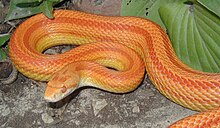
Amelanistic striped corn snake
- Motley – Has a clear belly and an "inverted" spotting blueprint. May besides appear equally stripes or dashes.
- Striped – This morph also has a articulate belly and a striping pattern. Unlike the Motley corn serpent, the striped corn snake's colors will not connect, simply may sometimes interruption up and take on a "cubed" appearance. Cubes and spots on a striped corn snake are the aforementioned as the saddle color on a similar-looking normal corn ophidian, unlike Motley corn snakes. Striped is both allelic and recessive to Motley, so breeding a striped corn ophidian and a (homozygous) Motley corn snake will result in all-Motley corn snakes and then breeding the (heterozygous) Motley corn snake offspring volition result in ¾ Motley corn snakes and ¼ striped corn snakes.
- Diffused – Diffuses the patterning on the sides and eliminates the belly pattern. It is i component of the Blood Ruby morph.
- Sunkissed – While considered a hypo-like gene, sunkissed corn snakes besides have other effects, such every bit rounded saddles and unusual head patterns.
- Aztec, Zigzag and Banded – Selectively bred multigenetic morphs that are not dependent on a single cistron.
Compound morphs [edit]
There are tens of thousands of possible chemical compound morphs. Some of the most pop ones are listed here.
- Snow (amelanistic + Anerythristic) – Every bit hatchlings, this color variation is composed of white and pinkish blotches. These corn snakes are predominantly white and tend to accept yellow neck and throat regions when mature (due to carotenoid retention in their diet). Light blotches and background colors accept subtle shades of biscuit, ivory, pink, green or yellow.
- Blizzard (amelanistic + Charcoal) – Totally white with carmine eyes, with very trivial to no visible pattern.
- Ghost (Hypomelanistic + Anerythristic type A) – Exhibit varying shades of grays and browns on a lighter background. These often create pastel colors in lavenders, pinks, oranges and tans.
- Phantom – A combination of Charcoal and Hypomelanistic.
- Pewter (Charcoal + Diffused) – Silvery-lavender, with very trivial pattern every bit adults.
- Butter (amelanistic + Caramel) – A two-tone yellow corn snake.
- Amber (Hypomelanistic + Caramel) – Take amber-colored markings on a light dark-brown background.

- Plasma (Diffused + Lavander) – Hatch out in varying shades of grayish-royal.
- Opal (amelanistic + Lavender) – Look like Blizzard corn snakes one time mature, with pink to purple highlights.
- Granite (Diffused + Anerythristic) – Tend to be varying shades of gray equally adults, with males often having pink highlights.
- Fire (amelanistic + Diffused) – An albino version of the Diffused morph. These corn snakes are typically very bright ruby snakes, with very little blueprint as adults.
Scale mutations [edit]
- Scaleless corn snakes are homozygous for a recessive mutation of the factor responsible for scale evolution. While non completely scaleless to a higher place, some do accept fewer scales than others. Yet, all of them possess ventral (belly) scales. They can also be produced with whatsoever of the aforementioned colour morphs. The beginning Scaleless corn snakes originated from the cantankerous of another North American rat snake species to a corn ophidian and they are therefore, technically, hybrids. Scaleless mutants of many other snake species have besides been documented in the wild.
Hybrids [edit]
Hybrids between corn snakes and any other snake is very mutual in captivity, merely rarely occurs in the wild. Hybrids within the genera Pantherophis, Lampropeltis, or Pituophis so far take been proven to be completely fertile.
Many different corn serpent hybrids are bred in captivity. A few mutual examples include:
- Jungle corn snakes are hybrids between a corn snake and a California kingsnake (Lampropeltis californiae). These show extreme pattern variations, taking markings from both parents. Although they are hybrids of different genera, they are non sterile.
- Tri-color Jungle corn snakes are hybrids betwixt a Querétaro kingsnake and a corn ophidian. The color is similar to that of an amelanistic corn snake.
- Creamsicle corn snakes are hybrids betwixt an albino corn snake and a Groovy Plains rat snake (P. emoryi). The start-generation hybrids are known as "Rootbeers". Convenance these back to each other tin produce Creamsicles.
- Turbo corn snakes are hybrids between a corn snake and whatsoever Pituophis species.
- Corn snakes hybridized with milk snakes are chosen a multifariousness of names, depending on the subspecies of milk snake used. For example, a Honduran milk ophidian × corn snake is chosen a Cornduran, a Sinaloan milk serpent × corn snake is called a Sinacorn and a Pueblan milk snake × corn snake is called a Pueblacorn.
- Brook Korn corn snakes are hybrids between a Beck's kingsnake and a corn serpent. Like the jungle corn snake, these hybrids too prove extreme pattern variations.
When hybrids of corn snakes are found in the wild, they have usually hybridized with other Pantherophis species whose ranges overlap with corn snakes.
References [edit]
- ^ Echternacht, A.; Hammerson, Yard.A. (2016). "Pantherophis guttatus". IUCN Red List of Threatened Species. 2016: due east.T63863A71740603. doi:10.2305/IUCN.UK.2016-three.RLTS.T63863A71740603.en . Retrieved 12 November 2021.
- ^ Stejneger L, Barbour T. 1917. A Cheque List of N American Amphibians and Reptiles. Cambridge, Massachusetts: Harvard University Press. four + 125 pp. (Elaphe guttata, p. 82).
- ^ "Pantheropis guttatus". The Reptile Database.
- ^ Crother, B. I. (2012). "Scientific and standard English names of amphibians and reptiles of North America n of United mexican states, with comments regarding conviction in our agreement" (PDF). Society for the Report of Amphibians and Reptiles Herpetological Circular. 39: 1–68.
- ^ Saviola, Anthony; Bealor, Matthew (2007). "Behavioural complexity and prey-handling ability in snakes: gauging the benefits of constriction". Behaviour. 144 (8): 907–929. doi:x.1163/156853907781492690. JSTOR 4536488.
- ^ "Corn Snake".
- ^ "Did Someone Say Snakes?". Archived from the original on 2013-08-03. Retrieved 2013-08-19 .
- ^ "FLMNH - Eastern Corn Snake (Pantherophis guttatus)". 17 Baronial 2020.
- ^ "Corn Snake | Petco". www.petco.com.
- ^ "Smithsonian National Zoo Corn Serpent Fact Sheet".
- ^ "Corn Ophidian Fact canvass". Smithsonian National Zoological Park.
- ^ Slavens, Frank; Slavens, Kate. "Elaphe guttata guttata". Archived from the original on 2015-09-24.
- ^ "Corn Serpent - Pantherophis guttatus". www.petmd.com.
- ^ "Reptiles and Amphibians of Virginia". Virginia Herpetological Society. Archived from the original on 2015-04-xiv. Retrieved 2014-11-27 .
- ^ Burbrink, Frank T. (Dec 2002). "Phylogeographic assay of the cornsnake (Elaphe guttata) complex equally inferred from maximum likelihood and Bayesian analyses". Molecular Phylogenetics and Evolution. 25 (3): 465–476. doi:10.1016/s1055-7903(02)00306-8. PMID 12450751.
- ^ Utiger, U., North. Helfenberger, B. Schätti, C. Schmidt, M. Ruf, and 5. Ziswiler, 2002. Molecular Systematics and Phylogeny of One-time and New World ratsnakes, Elaphe Auct., and related genera (Reptilia, Squamata, Colubridae). Russian Journal of Herpetology nine(two): 105-124.
- ^ Burbrink, Frank T.; Lawson, Robin (April 2007). "How and when did Old Globe ratsnakes disperse into the New World?". Molecular Phylogenetics and Evolution. 43 (1): 173–189. doi:10.1016/j.ympev.2006.09.009. PMID 17113316.
- ^ Pyron, R. Alexander; Burbrink, Frank T. (August 2009). "Neogene diversification and taxonomic stability in the snake tribe Lampropeltini (Serpentes: Colubridae)". Molecular Phylogenetics and Evolution. 52 (2): 524–529. doi:10.1016/j.ympev.2009.02.008. PMID 19236930.
- ^ Bartlett, Patricia; Bartlett, R. D. (2006-05-26), Corn Snakes and Other Rat Snakes, Consummate Pet Owner's Manual (2nd ed.), Hauppauge NY: Barron'southward Educational Series, ISBN978-0-7641-3407-4
- ^ "Jungle Corn Snakes".
- ^ Peterson Field Guide - Western Reptiles and Amphibians - 3rd Edition
- ^ "9 Interesting Facts About Corn Snakes".
- ^ "Corn serpent". Smithsonian's National Zoo. 2018-04-11. Retrieved 2021-05-23 .
- ^ "Eastern corn ophidian". Agriculture Victoria. 2020-05-21. Retrieved 2021-07-14 .
- ^ "American corn snake". Section of Main Industries, New S Wales, Australia . Retrieved 2021-07-14 .
- ^ "American corn snake". Business organisation Queensland. 2018-05-ten. Retrieved 2021-07-14 .
- ^ The Captive Breeding of Colubrid Snakes: This document, written by Steven T. Osborne, was originally published as a 4 part series in the 1982 edition ( Volume 4: Number 3,4,7, & nine ) of the San Diego Herpetological Society Newsletter.http://world wide web.kingsnake.com/colubrid/iv.html
- ^ "Fact Sheets Corn Snake" (PDF).
- ^ Griswold, William (Jan ane, 2001). "Captive Care and Breeding of the Corn Serpent, Elaphe guttata". Intendance in Captivity. 11 (iv): 37. Retrieved May 14, 2021.
- ^ "ADW: Pantherophis guttatus: INFORMATION". University of Michigan Museum of Zoology.
- ^ Greenwald, and Kanter, O. E. , Mar East. (July 1979). "Physiological and Biochemical Zoology". Physiological Zoology (Vol 52 ed.). The University of Chicago. 52 (3): 398–408. doi:10.1086/physzool.52.3.30155760. S2CID 87250648. Retrieved May 14, 2021.
- ^ Fry et al. 2012. sfn mistake: no target: CITEREFFry_et_al.2012 (help)
- ^ Allf, Bradley C.; Durst, Paul A. P.; Pfennig, David W. (October 2016). "Behavioral Plasticity and the Origins of Novelty: The Evolution of the Rattlesnake Rattle". The American Naturalist. 188 (iv): 475–483. doi:10.1086/688017. PMID 27622880. S2CID 3906174.
- ^ Saviola, Anthony; McKenzie, Valerie; Chiszar, David (19 Apr 2012). "Chemosensory responses to chemical and visual stimuli in five species of colubrid snakes". Acta Herpetologica. 7 (1): 91–103. doi:x.13128/Acta_Herpetol-9491.
- ^ Worthington-Hill, J.O.; Yarnell, R.W.; Gentle, L.Yard. (three July 2014). "Eliciting a predatory response in the eastern corn snake (Pantherophis guttatus) using live and inanimate sensory stimuli: implications for managing invasive populations" (PDF). International Periodical of Pest Direction. sixty (3): 180–186. doi:10.1080/09670874.2014.953230. S2CID 85416157.
- ^ University Of Rochester (February 8, 1999). "A Real Smart Asp: Snakes Show Surprising Ability To Learn". ScienceDaily . Retrieved 7 August 2021.
- ^ Holtzman, David A.; Harris, Terrence W.; Aranguren, Guillermo; Bostock, Elizabeth (Jan 1999). "Spatial learning of an escape task by immature corn snakes,Elaphe guttata guttata". Animal Behaviour. 57 (1): 51–threescore. doi:10.1006/anbe.1998.0971. PMID 10053071. S2CID 573713.
- ^ "Welcome to The Corn Snake.co.uk - Corn Snake Care Sheet, Corn Ophidian Facts, Corn Snake Photos, Corn Snake Forum, Corn Serpent Downloads and more than..." world wide web.thecornsnake.co.uk.
External links [edit]
- Feeding Corn Snake Video
- Ians Vivarium Guide to Cornsnake Morphs
- Thecornsnake.co.u.k.
- herpFocus – video female laying egg.
- Comprehensive Corn Snake care data
- American Cornsnake Registry
- The Cornsnake Morph Guide(R) – identification and genetic guide for collectors and breeders
- Corn serpent care canvass
- Ians Vivarium :: Guide to Cornsnake Morphs
- Corn snake genetics calculator – Genetics predication and calculations
- Scientific and Standard English language Names of Amphibians and Reptiles of North America Northward of Mexico, With Comments Regarding Confidence In Our Understanding. Edition 6.i
- Echternacht, A.; Hammerson, G.A. (2016). "Pantherophis guttatus". IUCN Blood-red Listing of Threatened Species. 2016: e.T63863A71740603. doi:10.2305/IUCN.Great britain.2016-3.RLTS.T63863A71740603.en . Retrieved 12 November 2021.
blubaughmolaing1962.blogspot.com
Source: https://en.wikipedia.org/wiki/Corn_snake
Belum ada Komentar untuk "How Do You Know if Your Snake Is a Corn Snake"
Posting Komentar