When Does Science Say a Fetus Is a Baby
Science Is Giving the Pro-life Motility a Boost
Advocates are tracking new developments in neonatal research and engineering—and transforming one of America'due south most contentious debates.
Updated at 2:15 p.m. ET on August 25, 2021
The first time Ashley McGuire had a infant, she and her husband had to expect 20 weeks to learn its sex. By her third, they constitute out at 10 weeks with a blood exam. Technology has divers her pregnancies, she told me, from the apps that track weekly development to the ultrasounds that prove the growing child. "My generation has grown up under an entirely different earth of science and applied science than the Roe generation," she said. "We're in a culture that is science-obsessed."
Activists like McGuire believe information technology makes perfect sense to exist pro-science and pro-life. While she opposes abortion on moral grounds, she believes studies of fetal development, improved medical techniques, and other advances anchor the movement'south arguments in scientific fact. "The pro-life bulletin has been, for the last 40-something years, that the fetus … is a life, and it is a human being life worthy of all the rights the rest of united states of america have," she said. "That's been more of an abstract concept until the last decade or so." Just, she added, "when y'all're seeing a baby sucking its pollex at 18 weeks, smiling, clapping," it becomes "harder to foursquare the idea that that 20-week-old, that unborn babe or fetus, is discardable."
Scientific progress is remaking the fence around abortion. When the U.South. Supreme Courtroom decided Roe v. Wade, the case that led the manner to legal ballgame, information technology pegged near fetuses' chance of viable life outside the womb at 28 weeks; after that point, it ruled, states could reasonably restrict women's admission to the procedure. Now, with new medical techniques, doctors are debating whether that threshold should be closer to 22 weeks. Like McGuire, today'due south prospective moms and dads can learn more about their baby earlier into a pregnancy than their parents or grandparents. And like McGuire, when they see their fetus on an ultrasound, they may see humanizing qualities like smiles or claps, fifty-fifty if most scientists see random muscle movements.
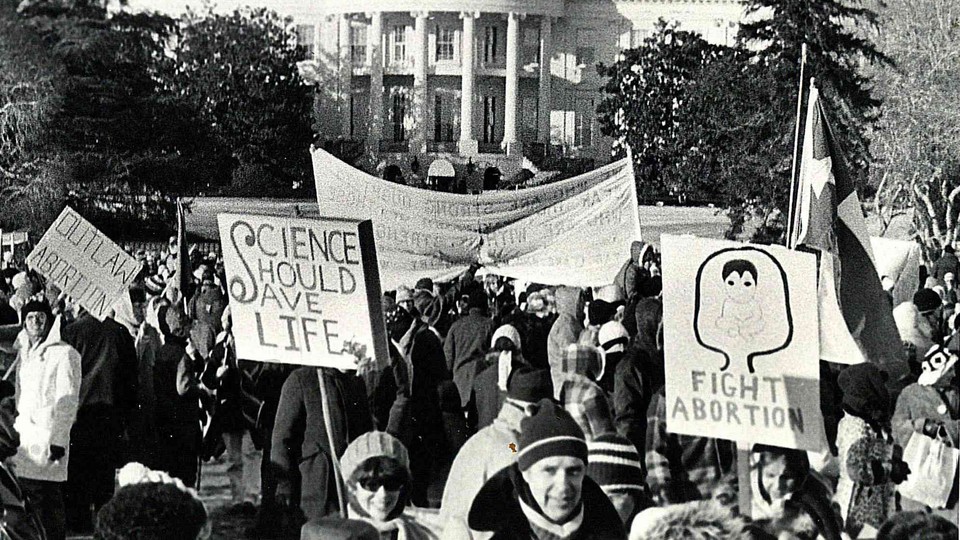
These advances fundamentally shift the moral intuition effectually abortion. New technology makes information technology easier to auscultate the humanity of a growing child and imagine a fetus as a creature with moral condition. Over the final several decades, pro-life leaders have increasingly recognized this and rallied the ability of scientific testify to promote their cause. They have built new institutions to produce, track, and distribute scientifically crafted information on ballgame. They hungrily follow new research in embryology. They gloat progress in neonatology equally a means to save young lives. New science is "instilling a sense of awe that we never really had earlier at whatsoever point in human history," McGuire said. "We didn't know whatever of this."
In many ways, this represents a dramatic reversal; pro-choice activists accept long claimed science for their ain side. The Guttmacher Institute, a enquiry and advocacy organization that defends abortion and reproductive rights, has exercised a near-monopoly over the data of abortion, serving as a source for supporters and opponents alike. And the pro-pick movement's rhetoric has matched its resources: Its proponents often describe themselves as the sole defenders of women's welfare and scientific consensus. The idea that life begins at conception "goes against legal precedent, scientific discipline, and public stance," said Ilyse Hogue, the president of the abortion-advancement group NARAL Pro-Choice America, in a recent op-ed for CNBC. Members of the pro-life move are "not really anti-ballgame," she wrote in some other piece. "They are against [a] world where women can contribute equally and chart our own destiny in means our grandmothers never idea possible."
In their own manner, both movements accept made the aforementioned play: Pro-life and pro-choice activists have come to run across scientific evidence equally the ultimate tool in the battle over abortion rights. But in recent years, pro-life activists have been more successful in using that tool to shift the terms of the policy debate. Advocates have introduced research on the question of fetal pain and whether abortion harms women's wellness to great effect in courtrooms and legislative chambers, even when they cite studies selectively and their findings are fiercely contested past other members of the university.
Not everyone in the pro-life movement agrees with this strategic shift. Some believe new scientific findings might work confronting them. Others warn that overreliance on scientific evidence could erode the potent moral logic at the center of their cause. The biggest threat of all, however, is non the potential harm to a detail movement. When scientific research becomes subordinate to political ends, facts are weaponized. Neither side trusts the data produced by their ideological enemies; reality becomes relative.
Abortion has always stood apart from other topics of political debate in American culture. Information technology has remained morally contested in a way that other social issues have non, at least in part because it asks Americans to answer unimaginably serious questions about the nature of man life. Just maybe this ambiguity, this scrambling of traditional left-right politics, was always unsustainable. Perhaps it was inevitable that abortion would go the way of the remainder of American politics, with two sides that share nothing lobbing claims of fact across a no-man's-land of moral fence.
* * *
When Colleen Malloy, a neonatologist and faculty fellow member at Northwestern Academy, discusses ballgame with her colleagues, she says, "information technology's kind of like the emperor is non wearing any clothes." Medical teams spend enormous try, time, and money to deliver babies safely and nurse premature infants dorsum to wellness. However physicians oftentimes back up abortion, fifty-fifty tardily into fetal development.
As medical techniques have become increasingly sophisticated, Malloy says, she has felt this tension acutely: A scattering of medical centers in major cities can now perform surgeries on fetuses while they're notwithstanding in the womb. Many are the same age as the small number of fetuses aborted in the 2nd or third trimesters of a mother's pregnancy. "The more than I avant-garde in my field of neonatology, the more it just became the logical choice to recognize the developing fetus for what it is: a fetus, instead of some sort of sub-human class," Malloy says. "It just became so obvious that these were just developing humans."
Malloy is one of many doctors and scientists who have gotten involved in the political debate over abortion. She has testified before legislative bodies nearly fetal hurting—the claim that fetuses can feel physical suffering, perhaps fifty-fifty prior to the bespeak of viability exterior the womb—and written letters to the U.S. Senate Judiciary Committee.
Her career besides shows the tight twine between the scientific discipline and politics of abortion. In improver to her piece of work at Northwestern, Malloy has produced work for the Charlotte Lozier Institute, a relatively new D.C. think tank that seeks to bring "the power of science, medicine, and research to carry in life-related policymaking, media, and debates." The organization, which employs a number of doctors and scholars on its staff, shares an office with Susan B. Anthony List, a prominent pro-life advancement organisation.
"I don't remember it compromises my objectivity, or whatsoever of our acquaintance scholars," says David Prentice, the institute's vice president and research director. Prentice spent years of his career every bit a professor at Indiana State University and at the Family Inquiry Quango, a conservative Christian grouping founded by James Dobson. "Any time in that location's an association with an advancement group, people are going to brand assumptions," he says. "What nosotros take to exercise is make our all-time effort to evidence that we're trying to put the objective science out hither."
This want to harness "objective science" is at the heart of the pro-scientific discipline bent in the pro-life motion: Science is a source of dominance that'due south ofttimes treated as unimpeachable fact. "The cultural authority of science has become so totalitarian, so purple, that everybody has to have scientific discipline on their side in order to win a contend," says Mark Largent, a historian of scientific discipline at Michigan Country University.
Some pro-life advocates worry about the potential consequences of overemphasizing the authority of scientific discipline in abortion debates. "The question of whether the embryo or fetus is a person … is not accountable by science," says Daniel Sulmasy, a professor of biomedical ethics at Georgetown Academy and sometime Franciscan friar. "Both sides tend to employ scientific data when information technology is useful towards making a indicate that is based on … firmly and sincerely held philosophical and religious convictions."
For all the means that the pro-life motion might exist seen as countering today's en vogue sexual politics, its obsession with scientific discipline is squarely of the moment. "We've become steeped in a culture in which merely the information thing, and that makes us, in some ways, philosophically illiterate," says Sulmasy, who is also a doctor. "We really don't have the tools anymore for thinking and arguing exterior of something that can be scientifically verified."
Sometimes, scientific discoveries have worked against the pro-life movement's goals. Jérôme Lejeune, a French scientist and devout Catholic, helped discover the cause of Down syndrome. He was horrified that prenatal diagnosis of the illness often led women to cease their pregnancies, all the same, and spent much of his career advocating against abortion. Lejeune eventually became the founding president of the Vatican's Pontifical Academy for Life, established in 1994 to navigate the moral and theological questions raised by scientific advances against a "'culture of death' that threatens to have control."
When scientific prove seems to undermine pro-life positions on issues such as birth control and in vitro fertilization, pro-lifers' enthusiasm for research sometimes wanes. For example: Some people believe emergency contraception, also known equally the morn-after pill or Plan B, is an abortifacient, significant it may end pregnancies. Considering the pill tin can forbid a fertilized egg from implanting in a woman's uterus, advocates argue, it could end a human life.
Sulmasy, who openly identifies equally pro-life, has argued against this view of the drug—and found information technology difficult to achieve his peers in the move. "Information technology's been very difficult to convince folks within the pro-life community that the scientific discipline seems to be … suggesting that [Program B] is not abortifacient," he says. "They are also readily dismissing that work as being motivated by advocacy."
And at a basic level, the argument for abortion is as well framed in scientific terms: The procedures are "gynecological services, and they're health-care services," Cecile Richards, the president of Planned Parenthood, says. This solitary is enough to make even gung-ho pro-life advocates wary. "Science for science's sake is non necessarily good," said McGuire, who serves as a senior fellow at the Catholic Association. "If annihilation, that's what gave u.s. abortion … When the moral and human ideals are removed from information technology, it's considered a medical procedure."
Even with all these internal debates and complications, many in the pro-life move feel optimistic that scientific advances are ultimately on their side. "Scientific discipline is a do of using systematic methods to report our world, including what homo organisms are in their early states," says Farr Curlin, a medico who holds joint appointments at Knuckles University'due south schools of medicine and divinity. "I don't see any way it's non an ally to the pro-life cause."
* * *
Pro-lifers' enthusiasm for science isn't ever reciprocated by scientists—sometimes, quite the opposite. Last summer, Vincent Reid, a professor of psychology at Lancaster University in the United Kingdom, published a paper showing that belatedly-development fetuses prefer to wait at face-like images while they're in the womb, just similar newborn infants. As Reid told The Atlantic's Ed Yong, the report "tells us that the fetus isn't a passive processor of environmental data. It'southward an agile responder."
Later his inquiry was published, Reid suddenly found himself showered with praise from American pro-life advocates. "I had a few people contacting me, congratulating me on my great piece of work, so giving a kind of religious overtone to it," he told me. "They'd cease off by saying, 'Anoint yous,' this sort of thing." Pro-life advocates interpreted his findings as testify that abortion is incorrect, even though Reid was studying fetuses in their third trimester, which business relationship for only a tiny fraction of abortions, he said. "It clearly resonated with them because they had a preconceived notion of what that scientific discipline ways."
Reid found the experience perplexing. "I'g very proud of what I did … because it made genuine advances in our understanding of human development," he said. "It'southward frustrating that people accept something which actually has no relevance to the position of anti-abortion or pro-abortion and endeavour to use it … in a way that's been pre-ordained." He'southward not going to end doing his enquiry on fetal evolution, he said. Just he "will probably exist a bit more than heavy, perhaps, in my anticipation of how it's going to exist misused."
This fate is almost impossible to avert in any field that remotely touches on ballgame or origin-of-life issues. "There [are] no people who are merely sitting in a lab, working on their projects," says O. Carter Snead, a professor of law and political science at Notre Dame who served as general counsel to President George W. Bush's Council of Bioethics. "Everybody is politicized." This is true fifty-fifty of researchers like Reid, who was blindsided by the reaction to his findings. "Y'all tin can't exercise this and non become sucked into somebody's orbit," says Largent, the Michigan State professor. "Anybody's going to have your work and use information technology for their ends. If you're going to do this, you either decide who's going to go to employ your piece of work, or information technology's done to yous."
That can have a chilling effect on scientists who work in sensitive areas related to conception or death. Abortion is "the third-rail of research," says Debra Mathews, an associate professor of pediatrics at Johns Hopkins who also has responsibleness for science programs at the university's bioethics institute.* "If y'all affect it, your research becomes associated with that argue." Although the abortion debate is important, she says, it tin can exist intimidating for researchers: "Information technology tends to envelop any it touches."
As often every bit not, scientists dive into the contend, taking funding from pro-life or pro-choice organizations or openly advancing an ideological position. This, too, has consequences: Information technology casts dubiety on the validity and integrity of any researcher in bioethics-related fields. "Everyone with coin tin become a scientist to say what they want them to say," Largent says. "That's not because scientists are whores. It'due south because the globe is a really circuitous place, and there are means that yous can craft a scientific investigation to lend acceptance to i side or another."
This can have a fun-house-mirror effect on the scientific argue, with scholars on both sides constantly criticizing the methodological shortcomings of their opponents and coming to contrary conclusions. For example: Priscilla Coleman is a professor at Bowling Greenish State Academy who studies the mental-health effects of abortion. Coleman has testified earlier Congress, and pro-life advocates cite her equally an important scholar working on this effect. At to the lowest degree some of her work, however, has been challenged repeatedly by others in her field: When she published a newspaper on the connection between abortion and anxiety, mood, and substance-abuse disorders in 2009, for instance, a number of scholars suggested her enquiry blueprint led her to depict fake conclusions. She and her co-author claimed they had made but a weighting error and published a corrigendum, or corrected update. Simply ultimately, the writer of the dataset Coleman used concluded that her "analysis does not back up … assertions that abortions led to psychopathology."
"If the results are questionable or not reproducible, then the study gets retracted. That'due south what happens in science," Coleman said in an interview. "The bottom line was that the pattern of the findings did not modify." She expressed frustration at media reports that questioned her piece of work. "I'k and so by trying to defend myself in these types of articles," she said. "To me, there isn't anything much worse than distorting science for an agenda, when the ultimate affect falls on these women who spend years and years suffering."
At least in one respect, she is correct: Many of her opponents practice have affiliations with the pro-choice movement. In this case, ane of the researchers questioning her work was associated with the Guttmacher Institute, a pro-ballgame arrangement. In an electronic mail, Lawrence Finer, the co-writer who serves as Guttmacher's vice president for research, said that Coleman'due south results were simply not reproducible. While Guttmacher advocates for abortion rights, the difference, Effectively claimed, is that it places a priority on transparency and integrity—which, he implied, the other side does not. "Information technology'south really not difficult to distinguish neutral analysis from advancement," he wrote in an email. "The fashion that'south done is by making one's belittling methods transparent and by submitting i's analysis—'neutral' or not—to peer review. No researcher—no person, for that affair—is neutral; everyone has an opinion. What matters is whether the researcher'southward methods are appropriate and reproducible."
"At that place is a false equivalence between the scientific discipline and what [Coleman] does," added Julia Steinberg, an banana professor at the University of Maryland's School of Public Wellness and Finer's co-author, in an email. "It'south not a debate, the way global warming is non a argue. At that place are people claiming global warming is non occurring, but scientists have compelling evidence that it is occurring. Similarly, there are people like Coleman, challenge ballgame harms women's mental health, only the scientists have compelling evidence that this is non occurring."
Yet, even the academy that establishes and promotes transparent methodologies for science inquiry has its own institutional biases. Considering support for legal abortion rights is unremarkably seen equally a neutral position in the academy, Sulmasy says, openly pro-life scholars may take a harder fourth dimension getting their colleagues to take their work seriously. "If an article is written by somebody who … is affiliated with a pro-life grouping or has a known pro-life stand on it, that scientific evaluation is typically dismissed equally advocacy," he said. "Prevailing prejudices within academia and media" decide "what gets considered to be advocacy and what is considered to be scientifically valid."
Pro-life optimists believe those biases might be irresolute—or, at least, they hope they've captured the territory of scientific authority. As the onetime NARAL president Kate Michelman told Newsweek in 2010, "The technology has conspicuously helped to define how people recall about a fetus as a full, breathing human being … The other side has been able to use the applied science to its ain end." In recent years, this has been the biggest modify in the ballgame fence, says Jeanne Mancini, the president of March for Life: Pro-selection advocates have largely given on upwards on the statement that fetuses are "lifeless blobs of tissue."
"In that location had been, a long time ago, this mantra from our friends on the other side of this issue that, while a little one is developing in its mother's womb, it's not a babe," she says. "It's really hard to make that argument when y'all come across and hear a heartbeat and lookout picayune hands moving around."
Ultimately, this is the pro-life motility's reason for framing its cause in scientific terms: The best statement for protecting life in the womb is establish in the common sense of fetal heartbeats and swelling stomachs. "The pro-life movement has always been a movement aimed at cultivating the moral imagination and so people tin understand why we should care near human beings in the womb," says Snead, the Notre Dame professor. "Science has been used, for a long time, equally a bridge to that moral imagination."
At present, the pro-life movement has successfully brought their scientific rallying cry to Capitol Hill. In a contempo promotional video for the Charlotte Lozier Plant, Republican legislators spoke warmly about how data help make the case for limiting ballgame. "When we have very difficult topics that nosotros need to talk about, the Charlotte Lozier Institute gives brownie to the testimony and to the information that we're giving others," says Tennessee Representative Diane Black. Representative Claudia Tenney of New York agreed: "We're winning on facts, and we're winning hearts and minds on scientific discipline."
This, above all, represents the shift in America's abortion contend: An upshot that has long been argued in normative claims about the nature of human life and women's autonomy has shifted toward a wobbly empirical fence. As Tenney suggested, it is a motility made with an eye toward winning—on policy, on public stance, and, ultimately, in courtrooms. The side result of this strategy, however, is ever deeper politicization and entrenchment. A deliberative commonwealth where fifty-fifty basic facts aren't shared isn't much of a democracy at all. Information technology'southward more of an exhausting tug-of-war, where the side with the most money and the best credentials is declared the winner.
* This article has been updated to clarify that Mathews helps run science programs at the Johns Hopkins Berman Constitute of Bioethics, rather than the establish itself. This story likewise originally stated that doctors perform surgeries on genetically aberrant fetuses while they are in utero. Fetuses that are treated this way are not necessarily genetically aberrant, nevertheless.
blubaughmolaing1962.blogspot.com
Source: https://www.theatlantic.com/politics/archive/2018/01/pro-life-pro-science/549308/
Belum ada Komentar untuk "When Does Science Say a Fetus Is a Baby"
Posting Komentar