Photograph of Sculpture 4 Statues in Orange Statues Walking on Each Other Art
| Konark Sun Temple | |
|---|---|
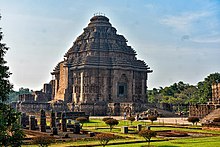 Principal construction of the Lord's day Temple | |
| Religion | |
| Affiliation | Hinduism |
| District | Puri |
| Deity | Surya |
| Festival | Chandrabhaga Melan |
| Governing body | ASI |
| Location | |
| Location | Konark, Puri district, Odisha, Bharat |
| State | Odisha |
| Country |  India India |
| Shown within India Testify map of India Konark Sun Temple (Odisha) Testify map of Odisha | |
| Geographic coordinates | 19°53′15″Northward 86°5′41″E / 19.88750°N 86.09472°E / 19.88750; 86.09472 Coordinates: 19°53′fifteen″N 86°5′41″E / 19.88750°Due north 86.09472°East / 19.88750; 86.09472 |
| Compages | |
| Manner | Kalinga |
| Creator | Narasimhadeva I |
| Completed | c. 1250 |
| Site area | 10.62 ha (26.2 acres) |
| Website | |
| konark | |
| UNESCO World Heritage Site | |
| Location | Konark, Odisha, India |
| Criteria | Cultural: (i)(three)(vi) |
| Reference | 246 |
| Inscription | 1984 (8th Session) |


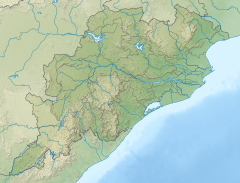
Konark Sun Temple is a 13th-century CE (yr 1250) Sun temple at Konark almost 35 kilometres (22 mi) northeast from Puri city on the coastline in Puri district, Odisha, India.[i] [two] The temple is attributed to king Narasimhadeva I of the Eastern Ganga dynasty about 1250CE.[3] [4]
Dedicated to the Hindu Sunday God Surya, what remains of the temple circuitous has the appearance of a 100-pes (30 m) high chariot with immense wheels and horses, all carved from stone. Once over 200 feet (61 g) high,[i] [5] much of the temple is now in ruins, in particular the large shikara tower over the sanctuary; at i fourth dimension this rose much higher than the mandapa that remains. The structures and elements that have survived are famed for their intricate artwork, iconography, and themes, including erotic kama and mithuna scenes. Also called the Surya Devalaya, information technology is a classic illustration of the Odisha style of Architecture or Kalinga architecture.[one] [vi]
The cause of the destruction of the Konark temple is unclear and still remains a source of controversy.[7] Theories range from natural damage to deliberate devastation of the temple in the course of being sacked several times by Muslim armies between the 15th and 17th centuries.[1] [seven] This temple was called the "Black Pagoda" in European crewman accounts equally early on as 1676 because it looked similar a peachy tiered tower which appeared black.[half-dozen] [8] Similarly, the Jagannath Temple in Puri was called the "White Pagoda". Both temples served as important landmarks for sailors in the Bay of Bengal.[9] [10] The temple that exists today was partially restored past the conservation efforts of British India-era archaeological teams. Declared a UNESCO world heritage site in 1984,[1] [2] it remains a major pilgrimage site for Hindus, who gather here every year for the Chandrabhaga Mela around the calendar month of February.[half dozen]
Konark Sun Temple is depicted on the reverse side of the Indian currency note of x rupees to signify its importance to Indian cultural heritage.[eleven]
Etymology [edit]
The name Konark (Koṇarka) derives from the combination of the Sanskrit words Koṇa (corner or angle) and Arka (the lord's day).[9] The context of the term Kona is unclear, merely probably refers to the southeast location of this temple either within a larger temple complex or in relation to other sun temples on the subcontinent.[12] The Arka refers to the Hindu sun god Surya.[nine]
The Sun temple of Konark, the Puri Jagannth temple and the Lingaraj temple of Bhubaneswar class a bilateral triangle. Konark temple forms one Koṇa (angular indicate of the triangle).[ citation needed ]
Location [edit]


Original temple and the surviving construction (xanthous), left; the temple plan, right
Temple is located in an eponymous village (at present NAC Area) about 35 kilometres (22 mi) northeast of Puri and 65 kilometres (forty mi) southeast of Bhubaneswar on the Bay of Bengal coastline in the Indian state of Odisha. The nearest airport is Biju Patnaik Airdrome in Bhubaneswar. Both Puri and Bhubaneswar are major railway hubs connected by Indian Railways.
The Konark Sun Temple was built in 1250 CE during the reign of the Eastern Ganga King Narsimhadeva-1 from stone in the form of a giant ornamented chariot defended to the Lord's day god, Surya. In Hindu Vedic iconography Surya is represented as rising in the east and traveling rapidly across the heaven in a chariot fatigued by 7 horses. He is described typically equally a resplendent standing person holding a lotus bloom in both his hands, riding the chariot marshaled by the charioteer Aruna.[xiii] [14] The seven horses are named afterwards the seven meters of Sanskrit prosody: Gayatri, Brihati, Ushnih, Jagati, Trishtubha, Anushtubha, and Pankti.[14] Typically seen flanking Surya are two females who correspond the dawn goddesses, Usha and Pratyusha. The goddesses are shown to exist shooting arrows, a symbol of their initiative in challenging the darkness.[xv] The architecture is also symbolic, with the chariot'southward twelve pairs of wheels corresponding to the 12months of the Hindu calendar, each month paired into ii cycles (Shukla and Krishna).[xvi]
The Konark temple presents this iconography on a yard scale. It has 24 elaborately carved stone wheels which are almost 12 feet (iii.7 m) in diameter and are pulled by a set of seven horses.[5] [2] [17] When viewed from inland during the dawn and sunrise, the chariot-shaped temple appears to emerge from the depths of the blue sea carrying the sun.[18]

1822 drawing of the mandapa'southward east door and terrace musicians

1815 sketch of rock horses and wheels of the mandapa
The temple plan includes all the traditional elements of a Hindu temple assail a foursquare plan. According to Kapila Vatsyayan, the footing programme, as well the layout of sculptures and reliefs, follow the square and circumvolve geometry, forms found in Odisha temple blueprint texts such equally the Silpasarini.[19] This mandala structure informs the plans of other Hindu temples in Odisha and elsewhere.[19]
The main temple at Konark, locally called the deul, no longer exists. It was surrounded by subsidiary shrines containing niches depicting Hindu deities, especially Surya in many of his aspects. The deul was built on a high terrace.[5] The temple was originally a complex consisting of the main sanctuary, called the rekha deul, or bada deul (lit. big sanctum).[18] In front of it was the bhadra deul (lit. minor sanctum), or jagamohana (lit. assembly hall of the people) (called a mandapa in other parts of India.[20]). The attached platform was called the pida deul, which consisted of a square mandapa with a pyramidal roof.[18] All of these structures were square at their core, and each was overlain with the pancharatha plan containing a variegated outside.[18] The central project, called the raha, is more pronounced than the side projections, called kanika-paga, a manner that aims for an coaction of sunlight and shade and adds to the visual appeal of the structure throughout the day. The blueprint transmission for this style is institute in the Silpa Sastra of ancient Odisha.[xviii] [21]

A stone wheel engraved in the walls of the temple. The temple is designed as a chariot consisting of 24 such wheels. Each wheel has a diameter of 9feet, 9inches, with 8spokes.
Twice as wide as they were high, the walls of the jagamohana are 100 feet (30 m) tall. The surviving construction has 3 tiers of six pidas each. These diminish incrementally and repeat the lower patterns. The pidas are divided into terraces. On each of these terraces stand statues of musician figures.[5] The main temple and the jagamohana porch consist of four chief zones: the platform, the wall, the trunk, and the crowning head called a mastaka.[22] The first three are square while the mastaka is circular. The main temple and the jagamohana differed in size, decorative themes, and design. It was the main temple's trunk, called the gandhi in medieval Hindu architecture texts, that was ruined long ago. The sanctum of the main temple is now without a roof and most of the original parts.[22]
On the east side of the master temple is the Nata mandira (lit. dance temple). It stands on a loftier, intricately carved platform. The relief on the platform is similar in style to that found on the surviving walls of the temple.[5] According to historical texts, at that place was an Aruna stambha (lit. Aruna'south pillar) betwixt the main temple and the Nata mandira, but it is no longer at that place because it was moved to the Jagannatha at Puri old during the troubled history of this temple.[5] According to Harle, the texts suggest that originally the complex was enclosed within a wall 865 feet (264 m) by 540 feet (160 yard), with gateways on iii sides.[5]
The sunday temple was made from iii types of stone.[23] Chlorite was used for the door lintel and frames as well as some sculptures. Laterite was used for the core of the platform and staircases near the foundation. Khondalite was used for other parts of the temple. Co-ordinate to Mitra, the Khondalite stone weathers faster over time, and this may take contributed to erosion and accelerated the damage when parts of the temples were destroyed.[23] None of these stones occur naturally nearby, and the architects and artisans must accept procured and moved the stones from distant sources, probably using the rivers and water channels near the site.[23] The masons so created ashlar, wherein the stones were polished and finished so every bit to make joints hardly visible.[23]
The original temple had a main sanctum sanctorum (vimana), which is estimated to have been 229 feet (70 m)[17] tall. The main vimana fell in 1837. The main mandapa audience hall (jagamohana), which is about 128 feet (39 grand) tall, however stands and is the principal structure in the surviving ruins. Among the structures that have survived to the current day are the dance hall (Nata mandira) and the dining hall (Bhoga mandapa).[two] [17]
Reliefs and sculpture [edit]

Particular of carved chariot wheel
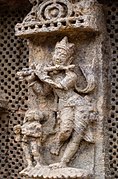

A young woman
The walls of the temple from the temple's base through the crowning elements are ornamented with reliefs, many finished to jewelry-quality miniature details. The terraces contain stone statues of male and female musicians holding various musical instruments including the vina, mardala, gini,[24] Other major works of fine art include sculptures of Hindu deities, apsaras and images from the daily life and culture of the people (artha and dharma scenes), various animals, aquatic creatures, birds, legendary creatures, and friezes narrating the Hindu texts. The carvings include purely decorative geometric patterns and plant motifs.[24] Some panels show images from the life of the king such as one showing him receiving counsel from a guru, where the artists symbolically portrayed the king as much smaller than the guru, with the rex's sword resting on the basis side by side to him.[25]
The upana (moulding) layer at the bottom of the platform contains friezes of elephants, marching soldiers, musicians, and images depicting the secular life of the people, including hunting scenes, a caravan of domesticated animals, people carrying supplies on their caput or with the help of a bullock cart, travelers preparing a meal forth the roadside, and festive processions.[26] On other walls are plant images depicting the daily life of the elite besides as the common people. For example, girls are shown wringing their moisture pilus, continuing by a tree, looking from a window, playing with pets, putting on makeup while looking into a mirror, playing musical instruments such equally the vina, chasing away a monkey who is trying to snatch items, a family taking get out of their elderly grandmother who seems dressed for a pilgrimage, a mother approving her son, a teacher with students, a yogi during a standing asana, a warrior being greeted with a namaste, a mother with her child, an old woman with a walking stick and a bowl in her hands, comical characters, among others.[27]
The Konark temple is as well known for its erotic sculptures of maithunas.[28] These show couples in diverse stages of courtship and intimacy, and in some cases coital themes. Notorious in the colonial era for their uninhibited commemoration of sexuality, these images are included with other aspects of human life too every bit deities that are typically associated with tantra. This led some to propose that the erotic sculptures are linked to the vama marga (left hand tantra) tradition.[5] However, this is not supported by local literary sources, and these images may exist the same kama and mithuna scenes institute integrated into the art of many Hindu temples.[5] The erotic sculptures are institute on the temple's Shikhara, and these illustrate all the bandhas (mudra forms) described in the Kamasutra.[20]
Other large sculptures were a role of the gateways of the temple complex. These include life-size lions subduing elephants, elephants subduing demons, and horses. A major pillar dedicated to Aruna, called the Aruna Stambha, used to stand in forepart of the eastern stairs of the porch. This, too, was intricately carved with horizontal friezes and motifs. It now stands in front of the Jagannatha temple at Puri.[29]
Hindu deities [edit]
The upper levels and terrace of the Konark Dominicus temple contain larger and more significant works of art than the lower level. These include images of musicians and mythological narratives every bit well equally sculptures of Hindu deities, including Durga in her Mahishasuramardini aspect killing the shape-shifting buffalo demon (Shaktism), Vishnu in his Jagannatha course (Vaishnavism), and Shiva as a (largely damaged) linga (Shaivism). Some of the improve-preserved friezes and sculptures were removed and relocated to museums in Europe and major cities of India before 1940.[30]
The Hindu deities are likewise depicted in other parts of the temple. For instance, the medallions of the chariot wheels of the Surya temple, likewise as the anuratha artwork of the jagamohana, testify Vishnu, Shiva, Gajalakshmi, Parvati, Krishna, Narasimha, and other divinities.[31] Also constitute on the jagamohana are sculptures of Vedic deities such as Indra, Agni, Kubera, Varuna, and Âdityas.[32]
Manner [edit]
The temple follows the traditional fashion of Kalinga architecture. It is oriented towards the eastward and so that the offset rays of the sunrise strike the main archway.[2] The temple, built from Khondalite rocks,[33] [34] was originally constructed at the mouth of the river Chandrabhaga, only the waterline has receded since then.[ citation needed ] The wheels of the temple are sundials, which tin can be used to calculate time accurately to a minute.[35]
Other temples and monuments [edit]
The Konark Sun Temple complex has ruins of many subsidiary shrines and monuments around the main temple. Some of these include:
- Mayadevi Temple – Located due west- been dated to the late 11th century, earlier than the main temple.[36] It consists of a sanctuary, a mandapa and, before information technology, an open platform. Information technology was discovered during excavations carried out betwixt 1900 and 1910. Early theories causeless that information technology was dedicated to Surya's wife and thus named the Mayadevi Temple. All the same, after studies suggested that it was also a Surya temple, albeit an older i that was fused into the circuitous when the monumental temple was built.[37] This temple also has numerous carvings and a square mandapa is overlain by a sapta-ratha. The sanctum of this Surya temple features a Nataraja. Other deities in the interior include a damaged Surya holding a lotus, forth with Agni, Varuna, Vishnu, and Vayu.[38]
- Vaishnava Temple – Located southwest of the so-called Mayadevi Temple, information technology was discovered during excavations in 1956. This discovery was meaning considering it confirmed that the Konark Lord's day Temple complex revered all the major Hindu traditions, and was non an exclusive worship identify for the saura cult as previously believed. This is a pocket-size temple with sculptures of Balarama, Varaha, and Vamana–Trivikrama in its sanctum, mark information technology every bit a Vaishnavite temple. These images are shown as wearing dhoti and a lot of jewelry. The sanctum's master idol is missing, as are images from some niches in the temple.[39] The site's significance as a place of Vaishnavism pilgrimage is attested to in Vaishnava texts. For example, Chaitanya, the early on 16th-century scholar and founder of Gaudiya Vaishnavism, visited the Konark temple and prayed on its premises.[forty]
- Kitchen – This monument is found southward of the bhoga mandapa (feeding hall). It, likewise, was discovered in excavations in the 1950s. It includes means to bring water, cisterns to store h2o, drains, a cooking flooring, depressions in the floor probably for pounding spices or grains, as well several triple ovens (chulahs) for cooking. This structure may accept been for festive occasions or a part of a community feeding hall.[41] According to Thomas Donaldson, the kitchen complex may accept been added a trivial later than the original temple.[42]
- Well ane – This monument is located north of the kitchen, towards its eastern flank, was probably built to supply water to the community kitchen and bhoga mandapa. Near the well are a pillared mandapa and 5 structures, some with semi-circular steps whose office is unclear.[43]
- Well 2 – This monument and associated structures are in the front of the northern staircase of the main temple, with pes rests, a washing platform, and a wash water drain arrangement. It was probably designed for the use of pilgrims arriving at the temple.[44]
A drove of fallen sculptures can be viewed at the Konark Archaeological Museum, which is maintained by the Archaeological Survey of India.[45] The fallen upper portion of the temple is believed to take been studded with many inscriptions.[46]
History [edit]
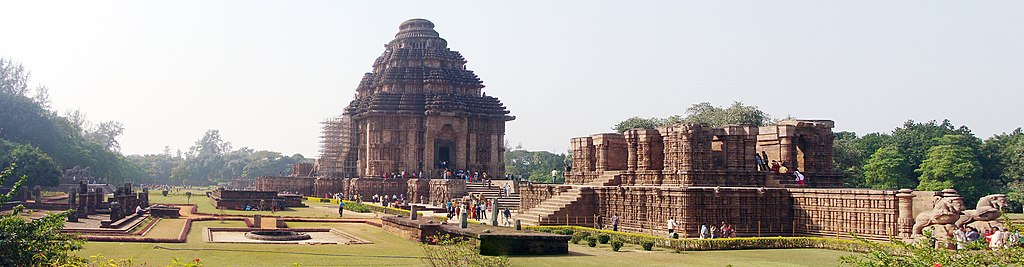
Konark Sun Temple panoramic view
Ancient texts [edit]
The oldest surviving Vedic hymns, such as hymn1.115 of the Rigveda, mention Surya with particular reverence for the "rising sun" and its symbolism as dispeller of darkness, one who empowers cognition, the good, and all life.[xiv] Still, the usage is context specific. In some hymns, the word Surya merely means lord's day as an inanimate object, a stone, or a jewel in the sky (Rigvedic hymns 5.47, 6.51 and 7.63) while in others it refers to a personified deity.[xiv] [47] [48] In the layers of Vedic texts, Surya is 1 of the several trinities along with Agni and either Vayu or Indra, which are presented as an equivalent icon and aspect of the Hindu metaphysical concept chosen the Brahman.[49]
In the Brahmanas layer of Vedic literature, Surya appears with Agni (burn down god) in the same hymns.[50] Surya is revered for the day, and Agni for its office during the night.[l] According to Kapila Vatsyayan, the concept of a Surya–Agni relationship evolves, and in later literature Surya is described as Agni representing the first principle and the seed of the universe.[51] It is in the Brahmanas layer of the Vedas,[52] [53] and the Upanishads that Surya is explicitly linked to the power of sight, and to visual perception and knowledge. He is and then internalized and said to be the center, as ancient Hindu sages suggested abandonment of external rituals to gods in favor of internal reflection and meditation of the gods within, in one's journey to realize the Atman (soul, cocky) inside, in texts such every bit the Brihadaranyaka Upanishad, Chandogya Upanishad, Kaushitaki Upanishad, and others.[54] [55] [56]
The Mahabharata ballsy opens its chapter on Surya by reverentially calling him the "eye of the universe, soul of all beingness, origin of all life, goal of the Samkhyas and Yogis, and symbolism for liberty and spiritual emancipation".[14] In the Mahabharata, Karna is the son of Surya and an unmarried princess named Kunti.[14] The epic describes Kunti's difficult life as an unmarried mother, then her abandonment of Karna, followed by her lifelong grief. Infant Karna is found and then adopted, and grows upward to get one of the central characters in the great battle of Kurukshetra where he fights his half-brothers.[57]
Konark in texts [edit]
Konark, likewise referred to in Indian texts past the name Kainapara, was a pregnant trading port past the early centuries of the common era.[58] The electric current Konark temple dates to the 13thcentury, though evidence suggests that a sun temple was built in the Konark area past at least the ninthcentury.[59] Several Puranas mention Surya worship centers in Mundira, which may have been the before proper name for Konark, Kalapriya (Mathura), and Multan (now in Pakistan).[60] The Chinese Buddhist pilgrim and traveler Hiuen-tsang (too referred to every bit Xuanzang) mentions a port city in Odisha named Charitra. He describes the city every bit prosperous, with v convents and "storeyed towers that are very high and carved with saintly figures exquisitely washed". Since he visited Republic of india in the 7thcentury, he could not have been referring to the 13th-century temple, but his description suggests either Konark or some other Odisha port city already featuring towering structures with sculptures.[forty]
According to the Madala Panji, there was at once another temple in the region built by Pundara Kesari. He may have been Puranjaya, the 7th-century ruler of the Somavasmi Dynasty.[61]
Construction [edit]
The current temple is attributed to Narasimhadeva I of the Eastern Ganga dynasty, r. 1238–1264CE–. It is one of the few Hindu temples whose planning and construction records written in Sanskrit in the Odia script have been preserved in the class of palm leaf manuscripts that were discovered in a village in the 1960s and after translated.[62] The temple was sponsored by the king, and its construction was overseen by Siva Samantaraya Mahapatra. Information technology was built almost an old Surya temple. The sculpture in the older temple's sanctum was re-consecrated and incorporated into the newer larger temple. This chronology of temple site's evolution is supported past many copper plate inscriptions of the era in which the Konark temple is referred to as the "smashing cottage".[40]
According to James Harle, the temple as congenital in the 13thcentury consisted of two chief structures, the dance mandapa and the great temple (deul). The smaller mandapa is the structure that survives; the great deul collapsed sometime in the late 16thcentury or after. Co-ordinate to Harle, the original temple "must originally have stood to a height of some 225 anxiety (69 m)", but simply parts of its walls and decorative mouldings remain.[five]
Damage and ruins [edit]

A lithography plate from James Fergusson's "Aboriginal Compages in Hindoostan" (1847) showing part of the main tower still standing
The temple was in ruins earlier its restoration. Speculation continues as to the crusade of the destruction of the temple. Early on theories stated that the temple was never completed and collapsed during construction. This is contradicted by textual prove and evidence from inscriptions. The Kenduli copper plate inscription of 1384CE from the reign of NarasimhaIv seems to bespeak that the temple was not simply completed merely an active site of worship. Some other inscription states that diverse deities in the temple were consecrated, too suggesting that construction of the temple had been completed.[63] A non-Hindu textual source, the Akbar-era text Own-i-Akbari by Abul Fazl dated to the 16thcentury, mentions the Konark temple,[twoscore] describing information technology as a prosperous site with a temple that made visitors "astonished at its sight", with no mention of ruins.[63] [64] [65] 200 years later, during the reign of the Marathas in Odisha in the 18th century, a Maratha holy human plant the temple abased and covered in overgrowth. The Marathas relocated the temple's Aruna stambha (colonnade with Aruna the charioteer seated atop it) to the Panthera leo'due south Gate entrance of the Jagannath Temple in Puri.
Texts from the 19th century do mention ruins, which means the temple was damaged either intentionally or through natural causes sometime between 1556 and 1800CE. After the Sun Temple ceased to attract faithful, Konark became deserted, left to disappear in dense forests for years.[66]
According to Thomas Donaldson, prove suggests that the impairment and the temple's ruined status tin be dated to betwixt the late 16thcentury and the early 17thcentury from the records of diverse surveys and repairs found in early on 17th-century texts. These also record that the temple remained a site of worship in the early 17thcentury. These records practice not state whether the ruins were being used by devotees to gather and worship, or part of the damaged temple was still in use for some other purpose.[67]
Aruna Stambha [edit]
In the final quarter of the 18th century, the Aruna stambha (Aruna colonnade) was removed from the entrance of Konark temple and placed at the Singha-dwara (Lion's Gate) of the Jagannath temple in Puri by a Maratha Brahmachari named Goswain (or Goswami).[68] [69] The pillar, fabricated of monolithic chlorite, is 33 feet 8 inches (10.26 m) alpine and is dedicated to Aruna, the charioteer of the Sun god.[69]
Preservation efforts [edit]

Watercolour painting of two European officers with a dog exploring the interior, 1812
In 1803 the Eastward Republic of india Marine Board requested the Governor Full general of Bengal that conservation efforts be undertaken. Even so, the only conservation measure put in place at the time was to prohibit farther removal of stones from the site. Lacking structural back up, the last part of the main belfry all the same continuing, a pocket-size broken curved section, collapsed in 1848.[lxx]
The then-Raja of Khurda, who had jurisdiction over this region in the early on 19thcentury, removed some stones and sculptures to utilise in a temple he was building in Puri. A few gateways and some sculptures were destroyed in the process.[71] In 1838 the Asiatic Club of Bengal requested that conservation efforts exist undertaken, simply the requests were denied, and but measures to prevent vandalism were put in place.[70]
In 1859 the Asiatic Order of Bengal proposed, and in 1867 attempted to relocate an architrave of the Konark temple depicting the navagraha to the Indian Museum in Calcutta. This try was abandoned as funds had run out.[lxx] In 1894 thirteen sculptures were moved to the Indian Museum. Local Hindu population objected to further impairment and removal of temple ruins. The government issued orders to respect the local sentiments.[70] In 1903, when a major excavation was attempted nearby, the then-Lieutenant governor of Bengal, J.A. Bourdillon, ordered the temple to be sealed and filled with sand to preclude the collapse of the Jagamohana. The Mukhasala and Nata Mandir were repaired by 1905.[63] [72]

Sound and light bear witness in Konark Temple
In 1906 casuarina and punnang trees were planted facing the bounding main to provide a buffer confronting sand-laden winds.[lxx] In 1909 the Mayadevi temple was discovered while removing sand and debris.[lxx] The temple was granted Earth Heritage Site status by the UNESCO in 1984.[2]
Reception [edit]
Sun Temple marks the high point of the Odisha style of Nagara architecture.[73]
The Nobel Laureate Tagore wrote,
Here the linguistic communication of stone surpasses the language of human.
The colonial-era reception of the temple ranged from praise to derision. Andrew Sterling, the early colonial-era administrator and Commissioner of Cuttack questioned the skill of the 13th-century architects, but also wrote that the temple had "an air of elegance, combined with massiveness in the whole structure, which entitles it to no small share of admiration", calculation that the sculpture had "a degree of taste, propriety, and freedom which would stand a comparing with some of our all-time specimens of Gothic architectural ornament".[76] The Victorian mindset saw pornography in the artwork of Konark and wondered why in that location was no "shame and guilt in this pleasure in filth", while Alan Watts stated that at that place was no comprehensible reason to separate spirituality from love, sex, and religious arts.[77] According to Ernest Binfield Havell, the Konark temple is "one of the grandest examples of Indian sculpture extant", calculation that they express "as much fire and passion every bit the greatest European art" such as that institute in Venice.[78]
Cultural significance [edit]
Religion is often at the centre of the Odia (previously Orissan) cultural expression, and Konark occupies an important space in it as office of The Gilded Triangle (Jagannath Temple, Puri, and the Lingaraja Temple of Bhubaneswar completing information technology) which represents the pinnacle of Odia (previously Orissan) masonry and temple compages.
Literature [edit]
Numerous poems, stories, and novels accept been written almost Konark, most of which explore or expand or reinterpret the tragedies inherent in the legends and stories around the temple. Virtually recently, Mohanjit's book of poems, Kone Da Suraj, which revolves effectually Konark, won the Kendra Sahitya Akademi Honour (i of the top awards for literature in India) for Panjabi language.[79]
The post-obit is a listing of notable Odia literary works based on or inspired by Konark:
- Sachidananda Routray was the second Odia to win the Jnanpith Award, considered the highest literary award in Bharat.[80] [81] [82] His most famous work is the long poem Baji Rout, which narrates the story of courage and sacrifice past a kid, similar to the tale of Dharmapada and his sacrifice for the masons who built Konark. He has written many poems based on the legends of Konarka:
- Bhanga Mandira
- Konarka
- Gopabandhu Das was a notable social activist and writer in pre-independence Bharat, who was instrumental in the germination of the state of Odisha. His epic poem Dharmapada [83] is one of the landmarks in Odia literature.[84]
- Mayadhar Mansingh is a noted Odia poet and writer, who was popularly known for the romantic and erotic metaphors in his work, earning him the nickname of Prēmika kabi (Lover poet). His poems on Konark include:
- Konarka
- Konarkara Lashya Lila
- Mumurshu Konarka
- Manoj Das is a celebrated Odia writer, with a Kendra Sahitya Akademi Award to his name, among many other recognitions and awards. His 2d volume of poems, Kabita Utkala (published in 2003), has four poems on Konark
- Dharmapada: Nirbhul Thikana
- Bruntahina Phulara Sthapati: Sibei Santara
- Konark Sandhane
- Kalapahadara Trushna: Ramachandi
- Pratibha Ray is a modern Odia novelist and brusk story writer who has found both critical and commercial success. Her book Shilapadma (published in 1983) won the Odisha Sahitya Academy Award and has been translated to six other languages.[85]
Additionally, the Sun Temple is the setting of "Interpreter of Maladies," a short story in Jhumpa Lahiri's Pulitzer Prize winning collection of the same proper name.
In heraldry [edit]

The Warrior and Horse statue found in the temple grounds forms the basis of the state emblem of Odisha.
Gallery [edit]
Historical images [edit]
-

Watercolour "Somnath" cartoon of the north side of Konark (1820). It depicts function of the main tower still continuing.
-

Photograph of a general view from the south-west (c.1890).
Electric current day photographs [edit]
-
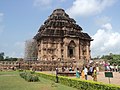
Chief Temple Structure, Konark Sunday Temple
-
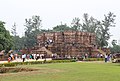
Nata mandir
-
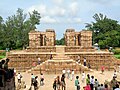
Front view of Nata mandir
-

A simha-gaja at the entrance
-

A weathered horse sculpture
-

Elephants of Konark Temple
-

A sculpture on the temple wall
-
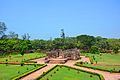
Mayadevi Temple at Konark
-

Sculpture of a makara on Mayadevi Temple
-

Vaishnava Temple
-

Sanctum of the Vaishnava Temple
-

Carvings on the Sunday temple
-

A sculpture on the temple wall
-

Replica of Sunday Temple at Gwalior
-

Closeup of the motif at the middle of a stone wheel
-
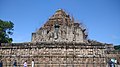
Back Side View of Konark Sun Temple
-

Rosasala or kitchen of the temple complex
-
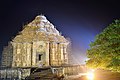
A long exposure photo of the beautiful Sun Temple, Konark, Odisha, at night
Encounter also [edit]
- Deo Surya Mandir
- History of Odisha
- Konark Dance Festival, an annual outcome held at this site
- Solar deity
- Sun temple
References [edit]
- ^ a b c d e Konark: India, Encyclopædia Britannica
- ^ a b c d e f "Lord's day Temple, Konârak". UNESCO. Retrieved 3 May 2013.
- ^ Sen, Sailendra (2013). A Textbook of Medieval Indian History. Primus Books. pp. 121–122. ISBN978-nine-38060-734-4.
- ^ Indian History. Tata McGraw-Loma Education. p. two. ISBN978-0-07-132923-one . Retrieved iii May 2013.
- ^ a b c d e f g h i j James C. Harle (1994). The Art and Architecture of the Indian Subcontinent. Yale University Press. pp. 251–254. ISBN978-0-300-06217-five.
- ^ a b c Linda Kay Davidson; David Martin Gitlitz (2002). Pilgrimage: From the Ganges to Graceland : an Encyclopedia. ABC-CLIO. pp. 318–319. ISBN978-1-57607-004-8.
- ^ a b Thomas Donaldson (2005). Konark. Oxford Academy Press. pp. xv–28. ISBN978-0-19-567591-vii.
- ^ Thomas Donaldson (2005). Konark. Oxford Academy Printing. p. 28. ISBN978-0-19-567591-vii.
- ^ a b c Debala Mitra 1968, p. 3.
- ^ Lewis Sydney Steward O'Malley (2007). Bengal District Gazetteer : Puri. Concept Publishing Company. p. 283. ISBN978-81-7268-138-8 . Retrieved 3 May 2013.
- ^ RBI to issue new Rs x notes with Konark Sun Temple motif
- ^ Karuna Sagar Behera (2005). Konark: The Black Pagoda. Government of Republic of india Press. pp. 1–2. ISBN978-81-230-1236-0.
- ^ T. Richard Blurton (1993). Hindu Art. Harvard Academy Printing. p. 208. ISBN978-0-674-39189-v.
- ^ a b c d e f Roshen Dalal (2010). Hinduism: An Alphabetical Guide. Penguin Books Republic of india. pp. 399–401. ISBN978-0-xiv-341421-6.
- ^ Heather Elgood (2000). Hinduism and the Religious Arts. Bloomsbury Academic. pp. 80–81. ISBN978-0-304-70739-iii.
- ^ Debala Mitra 1968, p. 38.
- ^ a b c "Official website: The Sun Temple". Tourism Department, Authorities of Orissa. Retrieved iii May 2013.
- ^ a b c d e Debala Mitra 1968, pp. 24–25.
- ^ a b Kapila Vatsyayan (1997). The Foursquare and the Circle of the Indian Arts. Abhinav. pp. 88–91, 96–100. ISBN978-81-7017-362-5.
- ^ a b Ananda K Coomaraswamy 1985, p. 116.
- ^ Alice Boner; Sadāśiva Rath Śarmā (1966). Silpa Prakasa Medieval Orissan Sanskrit Text on Temple Architecture. Brill. OCLC 999775106.
- ^ a b Debala Mitra 1968, pp. 27–29.
- ^ a b c d Debala Mitra 1968, pp. 29–31.
- ^ a b Debala Mitra 1968, pp. 31–33.
- ^ King Narasimha and his spiritual advisor: Konarak Temple, V&A Museum, Uk; Quote: "In this Konarak sculpture Narasimha is depicted with his guru, probably the yogi Acharyraja. As rex, Narasimha, named after the 'homo-lion' incarnation of the Hindu god Vishnu, ruled Odisha and neighbouring regions of eastern India from 1238 to 1264. He held political control over the region in which the Dominicus temple was constructed and was the actual patron of the temple, yet he is shown as smaller than his guru. The guru sits cantankerous-legged, with ane arm raised in a gesture of caption. The bearded male monarch, seated in the centre of the sculpture, is stripped of all royal symbols. His sword lies on the ground in forepart of him. Instead of a weapon he holds a palm-foliage manuscript, the original medium for transcribing sacred texts in India. Beside the male monarch are ii attendants: one sits reading a palm-leaf manuscript; the other stands with his hands joined together in a demonstration of reverence. On the lower register, on a smaller scale, four warriors stand with shields and weapons."
- ^ Debala Mitra 1968, pp. 38–41.
- ^ Debala Mitra 1968, pp. 41–47, 61–64.
- ^ "Konarak Sun Temple: Mithuna Sculptures". Archaeological Survey of India. Retrieved 17 May 2011.
- ^ Debala Mitra 1968, pp. 79–81.
- ^ Debala Mitra 1968, pp. 46–48.
- ^ Debala Mitra 1968, pp. 49–51.
- ^ Debala Mitra 1968, pp. 52–54, 65–67.
- ^ N. Chenna Kesavulu (2009). Textbook of Engineering Geology. Macmillan Publishers India Limited. p. 188. ISBN978-0-230-63870-nine . Retrieved 27 July 2013.
- ^ P. C. Varghese (2012). Engineering Geology for Ceremonious Engineers. PHI Learning Pvt. Ltd. p. 126. ISBN978-81-203-4495-2 . Retrieved 2 Baronial 2013.
- ^ Praharaj, Mayarani (December 2015). "Astronomical Heritage: The Lord's day Temple-Konark". Periodical of the Indian Institute of Architects. 80 (12): 17. Retrieved 8 May 2017.
- ^ "Globe Heritage Sites: Konarak Sun Temple". Archaeological Survey of Bharat. Retrieved 17 May 2013.
- ^ Debala Mitra 1968, pp. 86–89.
- ^ Debala Mitra 1968, pp. 86–93.
- ^ Debala Mitra 1968, pp. 96–100.
- ^ a b c d N. Due south. Ramaswami (1971). Indian Monuments. Abhinav. pp. 161–163. ISBN978-0-89684-091-1.
- ^ Debala Mitra 1968, pp. 101–103.
- ^ Thomas Donaldson (2005). Konark. Oxford University Press. pp. 34, 75. ISBN978-0-nineteen-567591-7.
- ^ Debala Mitra 1968, pp. 103–105.
- ^ Debala Mitra 1968, pp. 105–106.
- ^ "Archaeological Museum, Konarak". Archaeological Survey of India. Retrieved 17 May 2013.
- ^ Habib, Irfan (2007). Medieval Republic of india the study of a culture. National Volume Trust, Republic of india. p. 49. ISBN978-81-237-5255-vi.
- ^ Arthur Anthony Macdonell (1996). Vedic Mythology. Motilal Banarsidass. pp. 30–31. ISBN978-81-208-1113-iii.
- ^ Barbara A. Weightman (1996), Pokemon .org/stable/215141 Sacred Landscapes and the Phenomenon of Light, Geographical Review, Vol.86, No.ane (Jan.1996), pp. 59–71
- ^ Jan Gonda (1969), The Hindu Trinity, Anthropos, Bd. 63/64, H.1/2, (1968/1969), pp. 216, 219 with footnote 51, 212–226
- ^ a b H. Due west. Bodewitz (1976). The Daily Evening and Morning Offering (Agnihotra) According to the Brāhmanas. Motilal Banarsidass. pp. 36–39 with notes. ISBN978-81-208-1951-1.
- ^ Roy W. Perrett (2001). Indian Philosophy: Theory of value. Routledge. pp. 182–183. ISBN978-0-8153-3612-9.
- ^ Henk Bodewitz (1997), Jaiminīya Brāhmaṇa I, 1–65: Translation and Commentary, Brill Academic, ISBN 978-9004036048, pp. 254–258, 328–329
- ^ JC Heesterman (1985), The Inner Conflict of Tradition: Essays in Indian Ritual, Kinship, and Social club, University of Chicago Press, ISBN 978-0226322995, pp. 93–94, link at Google Books
- ^ Brihadaranyaka Upanishad Robert Hume (Translator), Oxford University Printing, pp. 96–97
- ^ Kausitaki Upanishad Robert Hume (Translator), Oxford University Press, pp. 302–303, 307–310, 327–328
- ^ Patrick Olivelle (1992), The Samnyasa Upanisads: Hindu Scriptures on Asceticism and Renunciation, Oxford University Press, ISBN 978-0195070453, pp. 147–151
- ^ G. B. Milner (2005). Natural Symbols in Due south Eastward Asia. Routledge. pp. 129–130. ISBN978-1-135-75287-iii.
- ^ Helaine Selin (2008). Encyclopaedia of the History of Science, Applied science, and Medicine in Non-Western Cultures. Springer. p. 1731. ISBN978-one-4020-4559-2 . Retrieved ii August 2013.
- ^ Linda Kay Davidson; David Martin Gitlitz (2002). Pilgrimage: From the Ganges to Graceland : an Encyclopedia. ABC-CLIO. p. 318. ISBN978-1-57607-004-8 . Retrieved 27 July 2013.
- ^ John Yard. Rosenfield (1967). The Dynastic Arts of the Kushans. [Mit Faks.]. University of California Printing. p. 195. GGKEY:0379L32LPNJ. Retrieved 27 July 2013.
- ^ "Konark Sun Temple: Introduction". Archaeological Survey of Republic of india. Retrieved 29 July 2013.
- ^ Boner, Alice; Dāsa, Rājendra Prasāda; Rath Śarmā, Sadāśiva (1972), New light on the Sun Temple of Koṇārka: four unpublished manuscripts relating to structure history and ritual of this temple, Chowkhamba Sanskrit Series Office
- ^ a b c "Konarak, Conservation". Archaeological Survey of India. Retrieved 27 July 2013.
- ^ Dr. Benudhar Patra (April 2006). "Antiquity of Arkakshetra Konark" (PDF). Orissa Review. Government of Odisha. Retrieved 27 July 2013.
- ^ Thomas Donaldson (2005). Konark. Oxford University Press. pp. i–iii. ISBN978-0-19-567591-seven.
- ^ Mahendra Narayan Behera (2003). Brownstudy on Heathenland: A Book on Indology. University Press of America. pp. 146–147. ISBN978-0-7618-2652-1.
- ^ Thomas Donaldson (2005). Konark. Oxford University Printing. pp. 16–28. ISBN978-0-19-567591-7.
- ^ Narayan Miśra (2007). Annals and Antiquities of the Temple of Jagannātha. Sarup & Sons. p. 19. ISBN978-81-7625-747-3 . Retrieved 1 August 2013.
- ^ a b Prajna Paramita Behera (June 2004). "The Pillars of Homage toLord Jagannatha" (PDF). Orissa Review. Government of Odisha. Archived from the original (PDF) on 22 February 2014. Retrieved 1 August 2013.
- ^ a b c d e f "Konark Conservation". Government of Odisha. Archived from the original on 8 March 2012. Retrieved one August 2013.
- ^ N. S. Ramaswami (1971). Indian Monuments. Abhinav Publications. p. 166. ISBN978-0-89684-091-1 . Retrieved 2 August 2013.
- ^ Sandeep Mishra (ten July 2010). "The Sun Temple of Orissa". The Times of India. Archived from the original on thirty December 2011. Retrieved 27 July 2013.
- ^ Ananda M Coomaraswamy 1985, pp. 115–116.
- ^ Manish Telikic Cagey (2 February 2009). India: Nation on the Move: An Overview of India's People, Civilization, History, Economy, It Industry, & More. iUniverse. p. 389. ISBN978-1-4401-1635-3 . Retrieved 17 May 2013.
- ^ Mulk Raj Anand; Mayadhar Mansinha; Charles Louis Fabri (1968). Konarak. Marg Publications. p. four.
- ^ N. S. Ramaswami (1971). Indian Monuments. Abhinav. pp. 163–166. ISBN978-0-89684-091-1.
- ^ David Kopf (1985), Sexual Ambivalence in Western Scholarship on Hindu India: A History of the Thought of Shakto-Tantrism, Comparative Civilizations Review, Volume 13, Number thirteen, pages 149–150
- ^ V Smith (2012). Art of India. Parkstone. pp. 109–112. ISBN978-1-78042-880-2.
- ^ "Sahitya Academy Accolade for Mohanjit". Tribune Republic of india. 6 Dec 2018. Retrieved 12 Feb 2019.
- ^ "Jnanpith - Honour Indian literary honour". Encyclopedia Britannica . Retrieved 12 February 2019.
- ^ "8 Indian Literary Awards That Promote Indian Writing". The Curious Reader. 6 Dec 2017. Retrieved 12 February 2019.
- ^ "Literary Awards in Bharat - Jnanpith Accolade (mapsofindia)". Retrieved 12 Feb 2019.
- ^ "Dharmapada by Gopabandhu Das" (PDF) . Retrieved 12 February 2019.
- ^ "ten things to know about Utkalmani Gopabandhu Das". Odisha Sun Times. Retrieved 12 February 2019.
- ^ "Assam gets a taste of governor'south literary skills - Times of India". The Times of India . Retrieved 12 February 2019.
Bibliography [edit]
- Prasanna Kumar Acharya (2010). An encyclopaedia of Hindu architecture. Oxford University Printing (Republished by Motilal Banarsidass). ISBN978-81-7536-534-half-dozen.
- Prasanna Kumar Acharya (1997). A Lexicon of Hindu Architecture: Treating of Sanskrit Architectural Terms with Illustrative Quotations. Oxford University Press (Reprinted in 1997 by Motilal Banarsidass). ISBN978-81-7536-113-iii.
- Vinayak Bharne; Krupali Krusche (2014). Rediscovering the Hindu Temple: The Sacred Compages and Urbanism of Republic of india. Cambridge Scholars Publishing. ISBN978-1-4438-6734-4.
- Alice Blooper (1990). Principles of Composition in Hindu Sculpture: Cave Temple Period. Motilal Banarsidass. ISBN978-81-208-0705-1.
- Alice Boner; Sadāśiva Rath Śarmā (2005). Silpa Prakasa. Brill Academic (Reprinted by Motilal Banarsidass). ISBN978-8120820524.
- Ananda Thousand Coomaraswamy (1985), History of Indian and Indonesian Art, Dover, ISBN9780486250052
- A.Grand. Coomaraswamy; Michael W. Meister (1995). Essays in Architectural Theory. Indira Gandhi National Eye for the Arts. ISBN978-0-xix-563805-9.
- Dehejia, V. (1997). Indian Art. Phaidon: London. ISBN 0-7148-3496-three.
- Adam Hardy (1995). Indian Temple Architecture: Grade and Transformation. Abhinav Publications. ISBN978-81-7017-312-0.
- Adam Hardy (2007). The Temple Architecture of Bharat. Wiley. ISBN978-0470028278.
- Adam Hardy (2015). Theory and Do of Temple Architecture in Medieval India: Bhoja's Samarāṅgaṇasūtradhāra and the Bhojpur Line Drawings. Indira Gandhi National Centre for the Arts. ISBN978-93-81406-41-0.
- Harle, J.C., The Fine art and Architecture of the Indian Subcontinent, 2nd edn. 1994, Yale University Press Pelican History of Art, ISBN 0300062176
- Monica Juneja (2001). Architecture in Medieval Bharat: Forms, Contexts, Histories. Orient Blackswan. ISBN978-8178242286.
- Stella Kramrisch (1976). The Hindu Temple Volume 1. Motilal Banarsidass (Reprinted 1946 Princeton University Press). ISBN978-81-208-0223-0.
- Stella Kramrisch (1979). The Hindu Temple Book 2. Motilal Banarsidass (Reprinted 1946 Princeton University Press). ISBN978-81-208-0224-7.
- Michael W. Meister; Madhusudan Dhaky (1986). Encyclopaedia of Indian temple architecture. American Institute of Indian Studies. ISBN978-0-8122-7992-4.
- George Michell (1988). The Hindu Temple: An Introduction to Its Meaning and Forms. University of Chicago Press. ISBN978-0-226-53230-1.
- George Michell (2000). Hindu Art and Architecture. Thames & Hudson. ISBN978-0-500-20337-8.
- Debala Mitra (1968), Konarak, Archaeological Survey of India
- T. A. Gopinatha Rao (1993). Elements of Hindu iconography. Motilal Banarsidass. ISBN978-81-208-0878-2.
- Ajay J. Sinha (2000). Imagining Architects: Creativity in the Religious Monuments of India. University of Delaware Printing. ISBN978-0-87413-684-5.
- Burton Stein (1978). South Indian Temples. Vikas. ISBN978-0706904499.
- Burton Stein (1989). The New Cambridge History of India: Vijayanagara. Cambridge Academy Press. ISBN978-0-521-26693-2.
- Burton Stein; David Arnold (2010). A History of Republic of india. John Wiley & Sons. ISBN978-i-4443-2351-ane.
- Kapila Vatsyayan (1997). The Square and the Circle of the Indian Arts. Abhinav Publications. ISBN978-81-7017-362-five.
External links [edit]
- Konark Lord's day Temple (Official Website), Tourism Department, Authorities of Odisha
- Konark Lord's day Temple, Earth Heritage Site, UNESCO
- Konark Sun Temple, Archaeological Survey of India
- Konark Dance Festival, Government of Odisha
- Iconography at Konark Temple, Rusav Kumar Sahu (2011)
blubaughmolaing1962.blogspot.com
Source: https://en.wikipedia.org/wiki/Konark_Sun_Temple
Belum ada Komentar untuk "Photograph of Sculpture 4 Statues in Orange Statues Walking on Each Other Art"
Posting Komentar